
Solo Mining vs Pool Mining: The Practical Differences
Solo mining at 5 TH/s expects one block roughly every 3,600 years, while a 2,500 TH/s solo operation expects one about every 7.2 years — and a pool pays the same expected value in small hourly pieces instead. The two models do not differ in what you earn on average; they differ in whether you can survive the gap between payments.

Key takeaways
- Expected time to a block scales linearly with hashrate: about 3,600 years at 5 TH/s, roughly 72 years at 250 TH/s and 7.2 years at 2,500 TH/s.
- A single block is worth 3.125 BTC of subsidy plus its transaction fees, about $266,544 at a BTC price of $85,294 before fees.
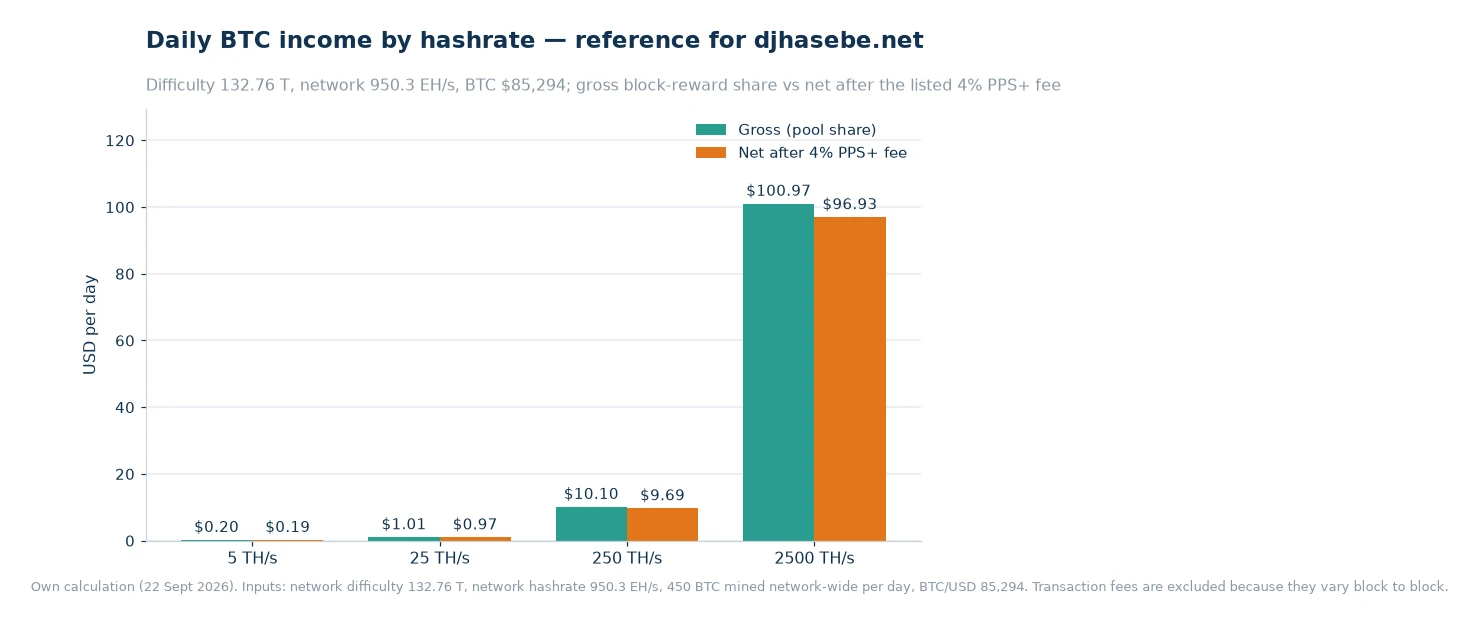
- Pooled, 2,500 TH/s earns about $100.97 a day gross and $96.93 net of the listed 4% PPS+ block-reward fee — paid hourly at current difficulty rather than once a decade.
- Under PPS+ the pool carries block-timing risk; under PPLNS, which carries a listed 2% fee on both components, you keep some of it.
The two models in one line each
Solo mining means you find your own blocks and keep the entire reward when one arrives, with no third party deciding when you get paid. Pool mining means many operators combine hashrate, the pool finds the blocks, and the reward is split by a published rule — either hourly at current difficulty under PPS+, or after 6 confirmations across the last 5 difficulty rounds under PPLNS.
Everything else follows from timing. Solo income is a rare, large, binary event. Pool income is a frequent, small stream whose size is set by your share of the pool and the network. The expected value over a long horizon is close to identical; the distribution is not remotely similar, and the distribution is what determines whether you can pay next month's power bill.
What solo mining means in numbers
The expectation is easy to compute and hard to feel. Your chance of finding any given block is your hashrate divided by the network's implied 950.3 EH/s, and the network produces 144 blocks a day. Divide one by the product and you have the average wait in days.
A 250 TH/s solo machine comes out at roughly 26,400 days, or 72 years. That does not mean the machine runs for 72 years; it means a 90-day dry spell covers about 0.3% of the expected wait, so dry spells are the normal condition rather than a fault. At 5 TH/s the same figure is about 1,320,000 days — a decade of uninterrupted hashing covers less than a third of one percent of the expectation.
| Hashrate | Share of network | Expected wait for one block | Expected value per day solo | Pooled net per day after the listed 4% PPS+ block-reward fee |
|---|---|---|---|---|
| 5 TH/s | about 0.00000053% | roughly 3,600 years | about $0.20 | $0.19 |
| 25 TH/s | about 0.0000026% | roughly 720 years | about $1.01 | $0.97 |
| 250 TH/s | about 0.000026% | roughly 72 years | about $10.10 | $9.69 |
| 2,500 TH/s | about 0.00026% | roughly 7.2 years | about $100.97 | $96.93 |
Worked example: identical expectation, different shape
Follow a 2,500 TH/s solo operation and the same hashrate in a pool through the same arithmetic.
Line one. Network hashrate of 950.3 EH/s is 950,300,000 TH/s, so 2,500 TH/s is a share of about 0.000263%.
Line two. Bitcoin issues 450 BTC a day, so the expected daily value of that share is 0.0011838 BTC, or $100.97 at $85,294 per BTC, before fees.
Line three. Solo, that value arrives as one block every 2,640 days or so. At 3.125 BTC per block, the subsidy alone is about $266,544, and dividing it by 2,640 days returns roughly $100.96 a day — the same number, delivered as a single event in seven years rather than a rolling average.
Line four. Pooled, the identical expected value is settled hourly at current difficulty under PPS+, at about $4.21 an hour gross and $96.93 a day net of the listed 4% fee on the block-reward component. That listed fee is effectively the price of never waiting for a block.
Line five. Scale the comparison: 1 PH/s returns about 0.014206 BTC, roughly $1,211.68, gross across 30 days, and the difference between a listed 4% and a listed 2% on the block-reward component is about $24.23 over that month.
Line six. Then price the risk you are taking. One hour offline at 1 PH/s costs about $1.68 of gross income, and a solo miner who is offline during the one block of the decade loses the whole event.
Where a pool changes the answer
A pool does three things a solo miner cannot do alone. It smooths income into a rate you can plan against, it lets small hashrate participate at all, and it removes the operational burden of running block templates and monitoring for the rare winning hash. In exchange for the listed 4% on the PPS-settled block reward, the pool absorbs the block-timing risk; under PPLNS the listed fee drops to 2% on both components but you keep part of that risk in the form of clustered, less predictable credits.
The choice is therefore about the shape of your costs. If you pay for power monthly and want income that matches, hourly settlement is a cash-flow instrument as much as a mining one. If you have capital to absorb long gaps and no fixed obligations, a lower listed fee on a variable base can be the better economics over a full cycle. The ViaBTC Mining Guide covers both payout modes side by side, including how the two components are treated, so the comparison rests on the published wording rather than on assumptions.
Two measurements make the decision concrete. Track real hashrate against nameplate so you know your true share rather than your rated one, using the pool Statistics view to confirm what the pool credited over the same period. Then put your own difficulty and price assumptions into the ViaBTC Mining Calculator and see whether the expected daily figure still covers power plus a reserve for downtime.
How to choose without guessing
- Start from the interval, not the reward. At 250 TH/s solo the expected wait is about 72 years; if that time frame is not acceptable, the decision is already made.
- Check whether you can fund a dry spell. A pool pays every hour; solo pays once per multi-year interval, and the two feel nothing alike on a bank statement.
- Read the fee base. A listed 4% on the block reward and a listed 2% on transaction fees under PPS+ is not the same deduction as a listed 2% on both components under PPLNS.
- Price the downtime honestly. Every offline hour removes expected value whether the model is solo or pooled, and solo removes the whole event if it lands in that hour.
- Remember it is reversible. Hashrate can move between models, so the first choice does not need to be the permanent one.
Frequently asked questions
Is pool mining less profitable than solo mining?
Over a long period the expected value is nearly the same. The pool's listed 4% fee on the PPS-settled block reward is the cost of removing block-timing risk, and at 2,500 TH/s that leaves $96.93 a day against $100.97 gross.
How likely is a solo miner to find a block?
Probability is your share of network hashrate, so at 250 TH/s it is about 0.000026% per block, which works out to one block roughly every 72 years on average.
What hashrate needs a pool?
Any hashrate small enough that a multi-year wait for one block would break the operating budget. At 5 TH/s the expected wait is about 3,600 years and pooled income is $0.19 a day after the listed fee.
Decide from the interval
Write down the expected wait for one block at your hashrate, then ask how many of those waits your cash flow can absorb without touching reserves. If the answer is less than one, a pool is the correct default and the listed fee is a cost of doing business rather than a deduction to minimise. If you can absorb several waits and prefer a lower listed fee on a variable base, PPLNS exists for exactly that trade, and difficulty is the only thing you need to watch to know when the arithmetic has changed.
Data and sources: ViaBTC listed fee schedule[1]. Difficulty (132.76 T), implied network hashrate (950.3 EH/s), the 144 blocks and 450 BTC issued daily, the 3.125 BTC subsidy and the BTC price of $85,294 were read from public chain data and market feeds on 22 September 2026; read 22 Sept 2026. All figures are arithmetic on those inputs, exclude transaction fees because they vary block by block, and are not a promise of earnings.